
3.1.1Who has the power?
The Power Rule
Notice that a tangent line to the graph has been drawn at
Write a slope statement for
. Use the secant line technique you developed in the Ramp Lab in Lesson 2.3.1 to approximate the slope at
. Be sure to extend the secant line so that you can use the grid lines to approximate the slope. If this graph represents the position of a roller coaster ride during its first six seconds, where is it moving the fastest?
Where is it moving the slowest? How did you determine your answers?How did the tangent lines help you complete parts (a) through (c)?
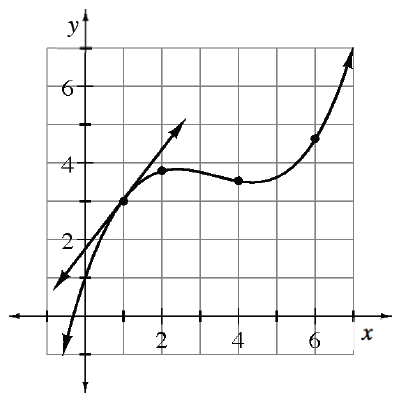
This can also be done using the 3-1 Student eTool. Click in the lower right corner of the graph to view it in full-screen mode.
On the Lesson 3.1.1B Resource Page, locate the graph of
With a ruler, accurately draw tangent lines for
. Using the same method you used in problem 3-1, determine the slope of the tangent line for each
-value and enter it into a table like the one below. On the resource page, graph the data from the table in part (b) and label it
. Use the table and the graph to write a slope function,
, a function that gives the slope of the line tangent to for any . What type of function is ?
Explore using the Slope at a Point eTool . Click in the lower right corner of the graph to view it in full-screen mode.
On the Lesson 3.1.1C Resource Page, locate the graph of
Explore using the Slope at a Point eTool. Click in the lower right corner of the graph to view it in full-screen mode.
Similarly, determine the slope function,
Explore using the Slope at a Point eTool. Click in the lower right corner of the graph to view it in full-screen mode.
Recall what you know about the finite differences of cubic, quadratic, and linear functions. How do the finite differences of these types of functions compare to their slope functions? Explain why.
SLOPE FUNCTIONS FOR
Write a general slope function
SLOPE FUNCTIONS FOR
You now know how to write an equation for the slope function for
Now let’s use
Vertical stretch: Compare and contrast the graphs of
and . For a given value of , which function has a steeper tangent line? For example, compare the slopes of the tangent lines at , which is steeper? By what factor? How about at ? ? ? Based on these examples, describe the relationship between and ? Then write an expression for . Vertical shift: Compare and contrast the graphs of
and . Consider the slopes of the corresponding tangent lines at various values of . Then use what you know about to write an equation for . Horizontal shift: Compare and contrast the graphs of
and . Describe how the tangent lines to correspond with the tangent lines to . Use what you know about to write an equation for . Write conjectures about the slope function,
, for each of the following polynomials: Write a general slope function,
, for a polynomial function of the form , that has been stretched and shifted horizontally and vertically.
.png)
SLOPE FUNCTION OF A SUM
What happens when we add polynomial functions? Write a conjecture regarding the slope function of

Write an expression using sigma notation that represents the sum of the areas of the rectangles shown for the function below. Note, the rectangles have equal widths. Homework Help ✎

Create a continuous function that contains three pieces: one that is a sine curve, one that is a square root curve, and one that is a parabola. Write the function using correct notation. 3-10 HW eTool. Homework Help ✎
Below is a graph of the function
.png)
Without your calculator, evaluate each limit. Homework Help ✎

Is the function graphed at right continuous at the following values of
.png)
For the graph in problem 3-13, state the domain and range using interval notation. Homework Help ✎
Recall the conjecture you developed in problem 3-5 and use it to determine the slope function,
After class, Stevie travels in a straight hallway with a velocity shown in the graph at right, where
Explain what is happening when
minutes. Calculate the total distance Stevie traveled.
If Stevie only travels in the straight hallway, how far does he end up from his original starting place?
What is Stevie’s acceleration at
? When is Stevie’s acceleration equal to zero?
.png)
Sketch
Rewrite
as a piecewise-defined function. What is the domain of
?
Evaluate each limit. If the limit does not exist due to a vertical asymptote, then add an approach statement stating if


